
The Book of Ballykinlar Comes to Kerry Writers’ Museum
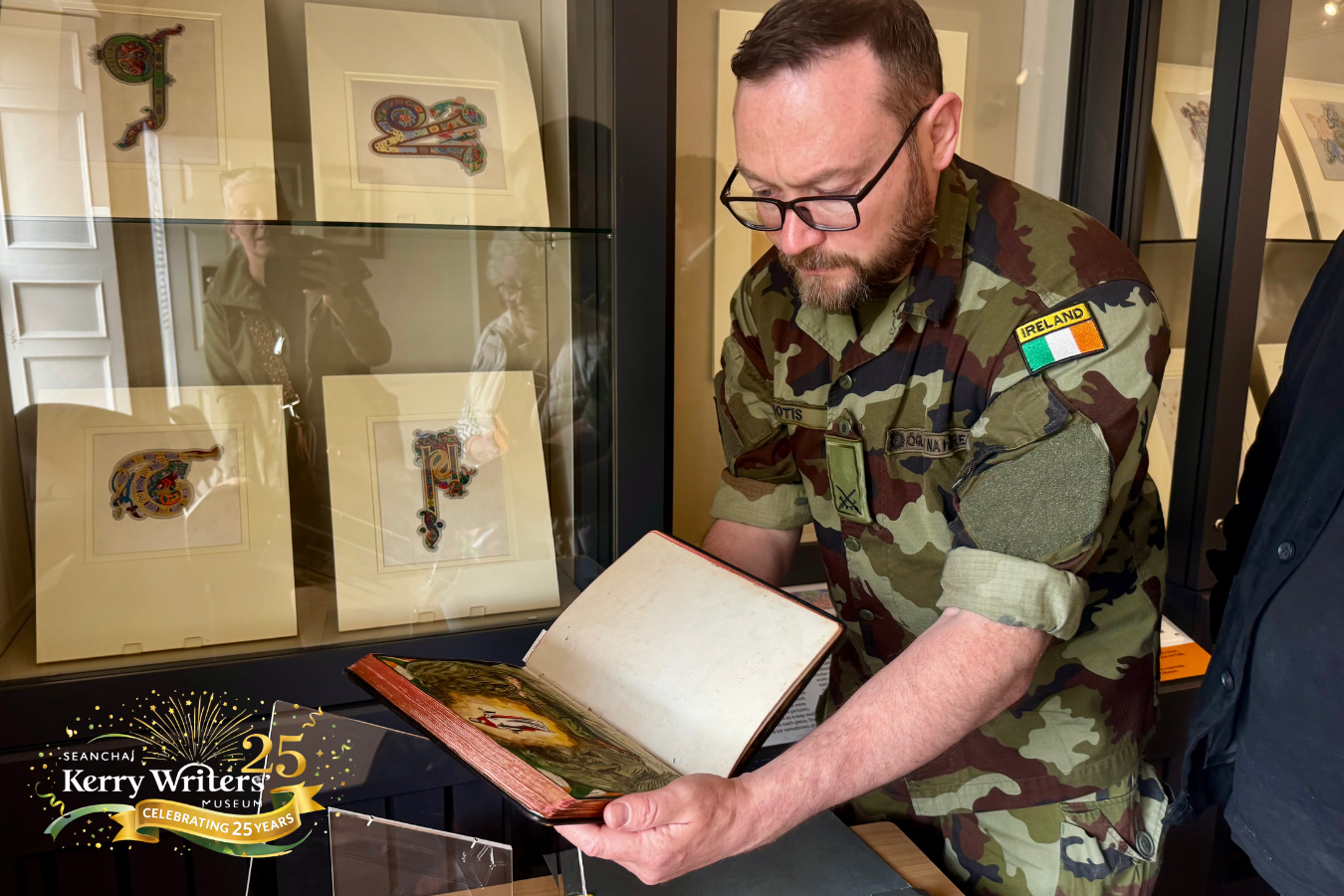
As part of the forthcoming Listowel Celtic Arts Weekend, Kerry Writers’ Museum was honoured to welcome Daniel Ayiotis, Director of the Military Archives, for a special preview visit accompanied by one of the most remarkable cultural treasures of Ireland’s revolutionary period — The Book of Ballykinlar.
More than an archive, this extraordinary volume is a meeting place of memory, artistry and resilience. Created by republican internees in Ballykinlar Camp between 1919 and 1921, its pages hold signatures, stories and exquisite Celtic artwork shaped during a defining chapter of Irish history.
In the following guest article, Daniel Ayiotis offers a fascinating insight into the work of the Military Archives and the remarkable journey of The Book of Ballykinlar — from its origins in internment and devotion to its place today as a rare and nationally significant work of Irish cultural heritage. His reflections reveal not only the vital role archives play in preserving our collective memory, but also the enduring power of art and storytelling to survive even the most difficult of circumstances.
The Military Archives
I have worked at the Military Archives for eleven of my nearly twenty-four years in the Army, the majority of that time as the archive’s director. Holding an appointment for that long is unusual; most officers hold appointments for one to three years. This is necessary to both develop a broad, generalist skill-set among senior leadership and to account for the dynamic nature of a career where overseas service, operational requirements and continuous training and education are defining features. The Military Archives however, has always been an exception.
First established as a sub-section of Army Intelligence in 1924, its function was to take into its custody valuable military records inherited by the newly established National Army, and to assist in the verification of pre-Truce service for applicants under the Army Pensions Act 1923 and Military Service Pensions Act 1924. During its first two years it was jointly overseen by Captain Alphonsus Blake and civilian clerk (and Kerryman!) Thomas Galvin. Both men left the Army in 1926 and it did not develop further until the appointment of Colonel JJ ‘Ginger’ O’Connell as its first ‘officer-in-charge’ in 1935.
O’Connell had been a senior member of the Irish Volunteers in 1916, of the IRA during the War of Independence, and the Deputy Chief of Staff of the National Army in 1922 – it was his kidnapping by anty-Treaty IRA in the Four Courts that was the casus belli for the outbreak of the Civil War. Accepting demotion from general to colonel as part of the post-Civil War demobilisation, he was the only pre-independence general not to be subsequently promoted to that rank again. His loss was the Military Archives gain however, as under his leadership it flourished, becoming more nationally prominent and outward looking, engaging and collaborating with other cultural and heritage bodies. The Military Archives entered another period of stagnation following his death in service in 1944, and during a reorganisation of the Forces in 1959 it was removed from ‘CS4’ – the document defining the staffing and structure of the Defence Forces, meaning it no longer officially existed.
It was 1982 when the Military Archives was re-established, following the efforts of Captain (later Commandant) Peter Young. Peter brought the Archives from obscurity to national prominence during his tenure as director (1982-1999), so much so that in 1990 the Military Archives was designated a statutory ‘place of deposit’ under section 14 of the National Archives Act. This means that it fulfils the functions of the National Archives for the Defence Forces (Army, Naval Service and Air Corps) and the Department of Defence.
In 2016, a new building for the Military Archives was opened at Cathal Brugha Barracks. This includes a 16 seat public reading room (fittingly named in honour of Commandant Peter Young) and a climate controlled archival repository containing approximately 21 linear kilometres of shelving. I successfully applied for an advertised position at the Military Archives in May 2015, a time when it was on the cusp of its greatest advance since its establishment. One of the requirements of an appointment there was that I undertook the MA in Archives and Records Management at UCD, and by the time I had graduated in 2016 we were ready to occupy the new facility.
The Book of Ballykinlar
Working at the Military Archives is varied and rewarding. One of the areas I most enjoy is outreach and collaboration. We have items on loan to museums in all four provenances and in the last decade alone have contributed to numerous projects, conferences, publications and exhibitions. We arealways on the lookout for new opportunities to cross-pollinate and the most recent of these has been with the Kerry Writers Museum, as part of the Listowel Celtic Arts Weekend this 11-14 June. Over the course of that weekend, we are delighted to have the opportunity to display The Book of Ballykinlar.
The Book of Ballykinlar is, in fact, one of two ‘Books of Ballykinlar’, one held by the Military Archives and one at the National Museum of Ireland. This is down to the fact that Ballykinlar was sub-divided into two camps (Camp 1 and Camp 2). Both are rare works of art; the one at the Military Archives contains the signatures of the internees at both camps, and as such could be considered as the premier book. The one at the National Museum, complied at Camp 2, contains only the names of internees at that camp but is more lavishly embellished. The keeping of autograph books was a very common practice at the time. Similar books were produced at other internment sites, and the smaller, less ornate, more general type of autograph books are relatively common. The Books of Ballykinlar, however, are without a doubt the prime examples of their genre and of early 20th century Celtic art.
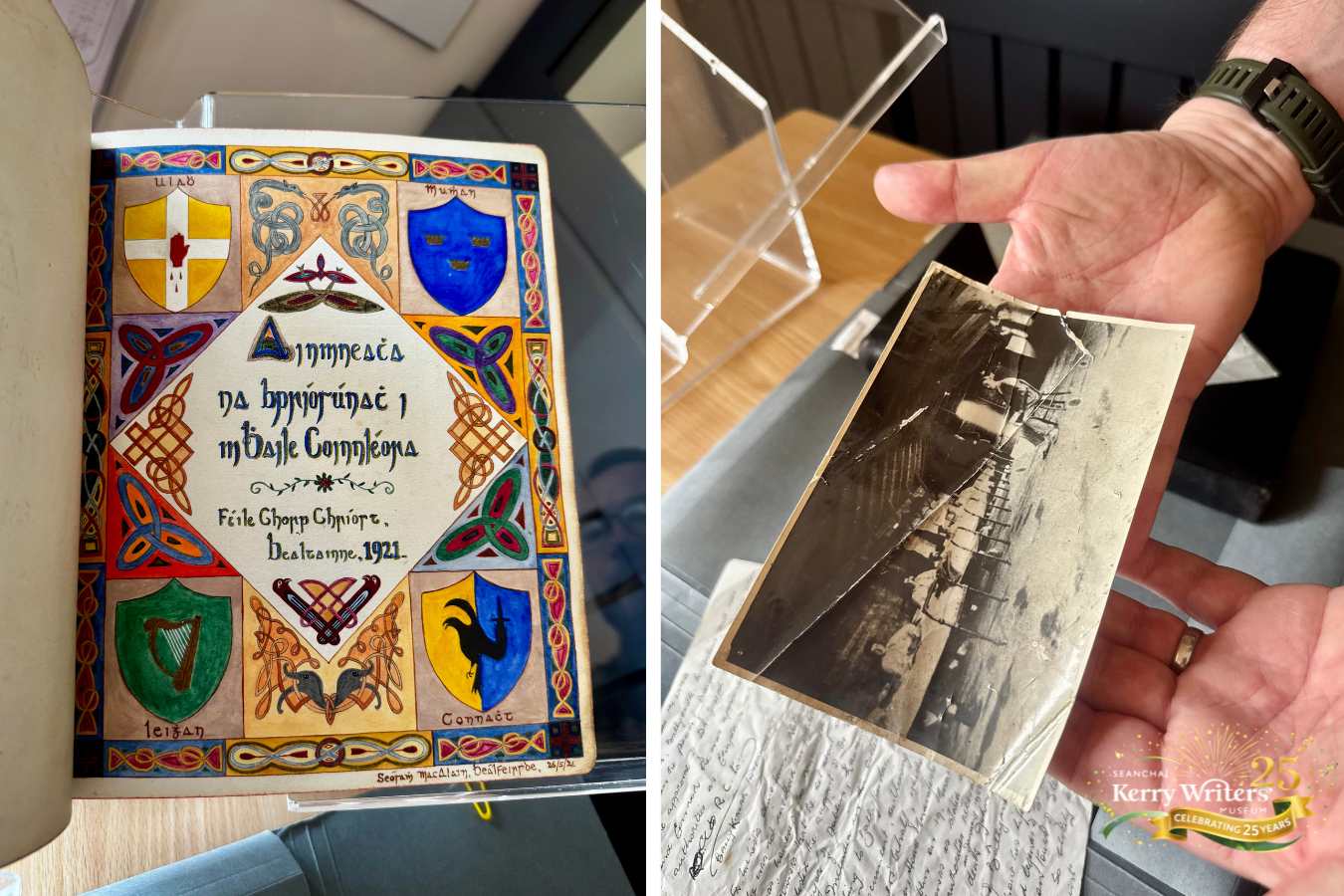
The book, made of high quality, gilt-edged art paper bound in black Morocco leather, is beautifully illustrated with watercolours depicting camp life and symbolic designs. Its dimensions are approximately 8 ½ x 10 ½ x 1 ¼ inches. It was created by republican internees held at Ballykinlar Internment Camp, County Down, during 1919-1921 and was dedicated to their chaplain, Fr John McLister. The high esteem in which he was held by the prisoners was further reflected in their presentation to him of a gold chalice upon the closing of the internment camp. The chalice, an illustration of which appears as the centrepiece of the book, was produced from raw material donated by the internees in the form of personal items such as cuff links, gold coins, rings etc.
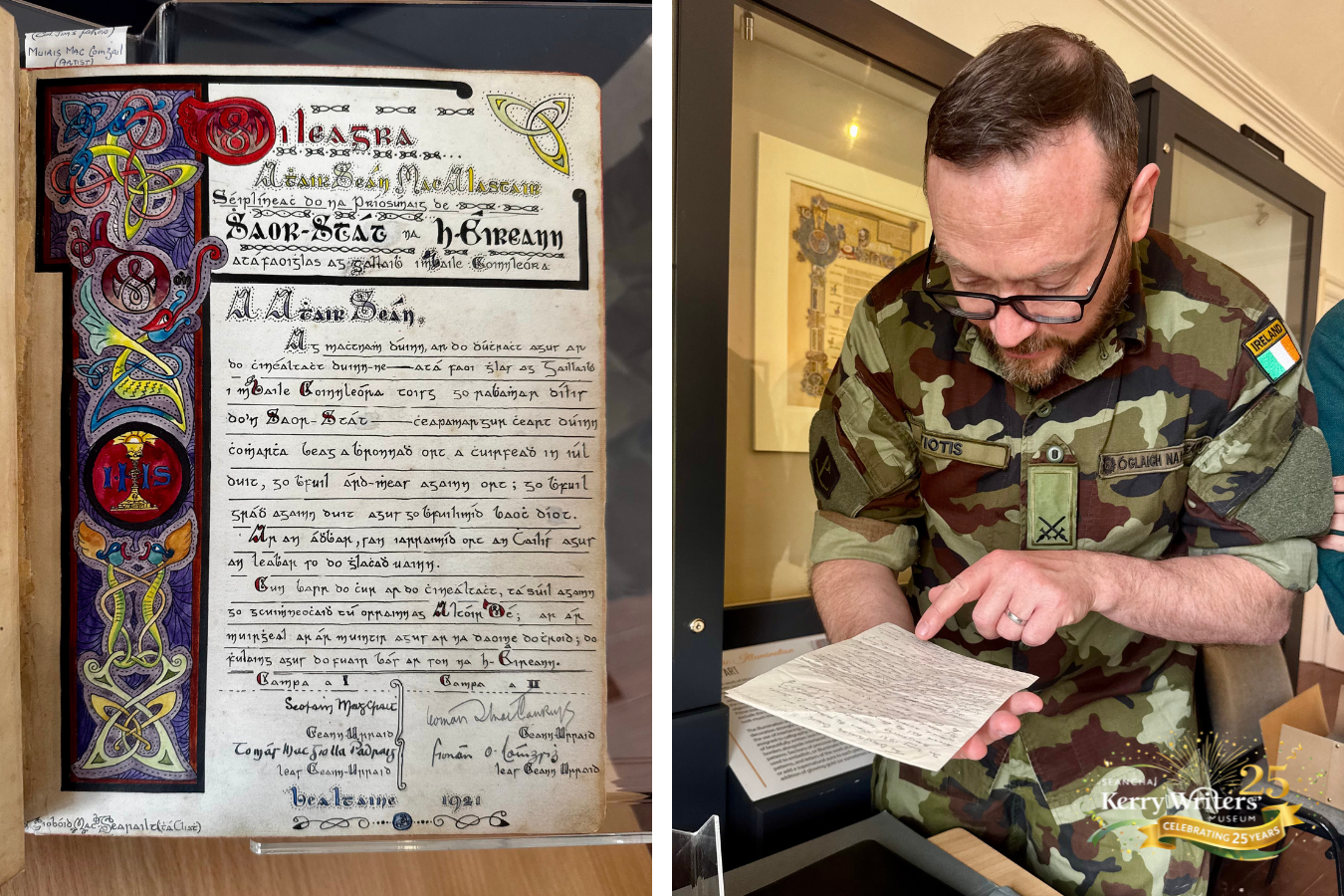
The book contains the names of many notable figures (all in Gaelic script) from the Irish revolutionary period. Not least among them is the name Aodh (Hugo) Mac Neill, who went on to become a Major General in the Army and one of two divisional commanders (alongside Major General MJ Costello) in a substantially expanded Army during the Emergency period. A man of artistic as well as academic inclination, MacNeill produced several sketches and watercolours of Ballykinlar, three of which we are delighted to have on exhibition alongside the Book of Ballykinlar.
Listowel Celtic Arts Weekend
Experience The Book of Ballykinlar in person during the Listowel Celtic Arts Weekend, taking place 11–14 June at Kerry Writers’ Museum.
The book will be on display throughout the entire weekend — a rare opportunity to encounter this extraordinary work of Irish history and Celtic artistry up close, and one not to be missed. To find out more and to book events go to https://www.eventbrite.ie/o/idca-listowel-celtic-art-weekend-2026-107958378461
The weekend brings together talks, workshops, exhibitions and performances celebrating Celtic art and heritage across Listowel.
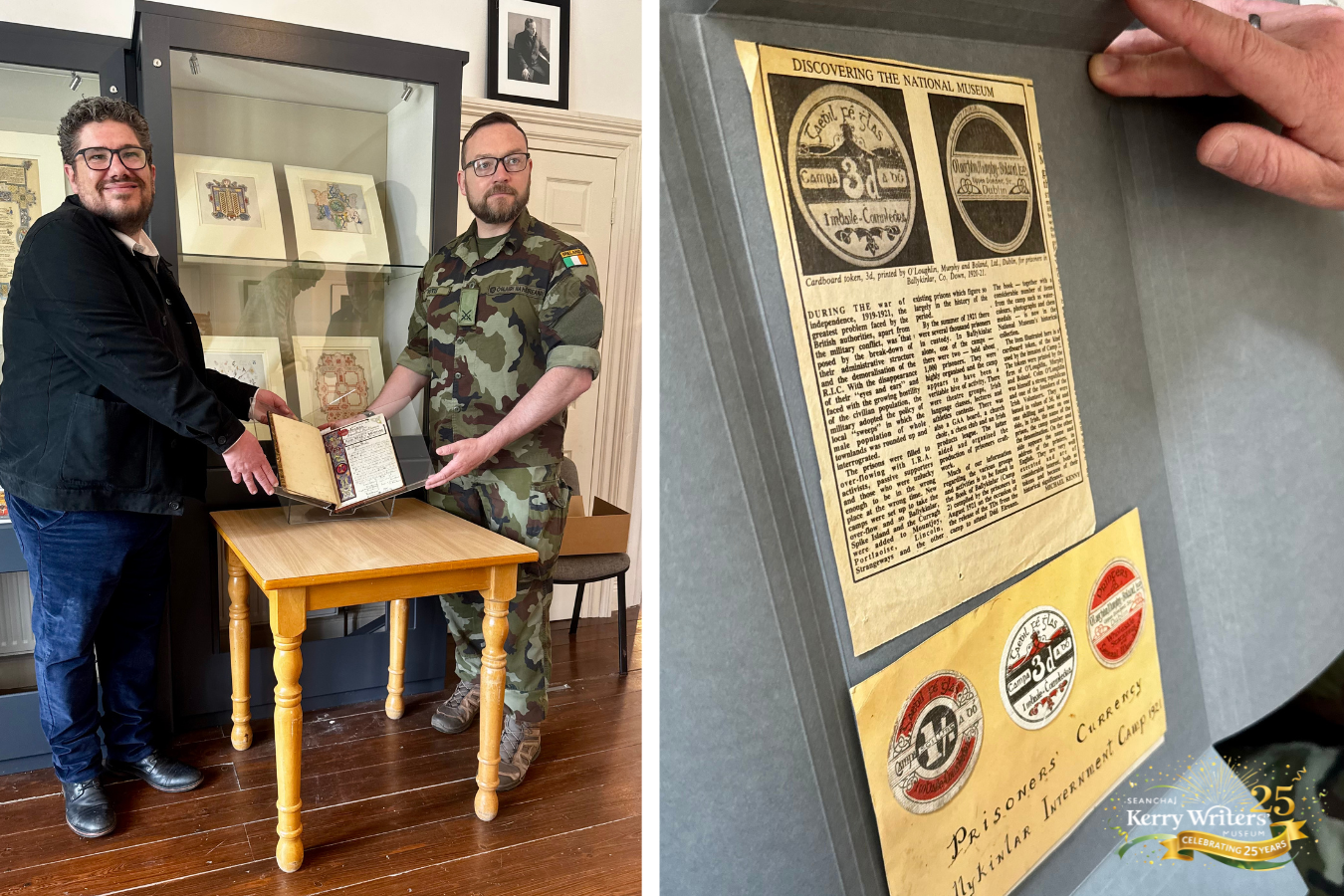
Photographs by Louise Lynch, documenting the visit of the Book of Ballykinlar to Kerry Writers’ Museum.